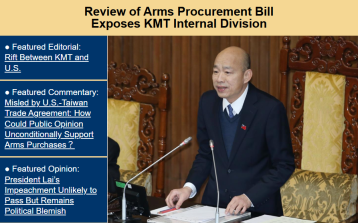
Rift Between KMT and U.S.
The Kuomintang’s (KMT) recent handling of the proposed “Special Act for Defense Procurement” has sparked major internal controversy. KMT Vice Chairman Chi Lin-lien declared at the Central Standing Committee that he would put righteousness above personal ties and expel Speaker Han Kuo-yu of the Legislative Yuan from the party. The divide between pro-American and American-skeptic factions within the party has intensified. At its core, the reason lies in the fact that since the KMT became an opposition party, its distance from the United States has grown ever wider. The resulting mistrust and lack of understanding have led to the current deadlock. The scale of the contradiction is likely something even the United States, which has been actively lobbying recently, did not anticipate.
...read more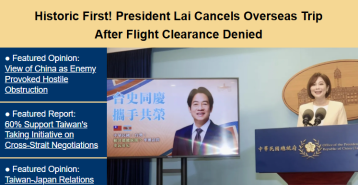
View of China as Enemy Provoked Hostile Obstruction
President Lai Ching-te’s visit to African diplomatic ally Eswatini has been postponed after overflight permits for the presidential aircraft were canceled by three countries including Mauritius. The interference was, of course, orchestrated by the Communist China, but the originator is President Lai himself.
...read more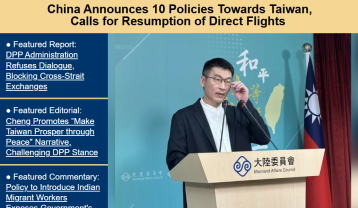
DPP Administration Refuses Dialogue, Blocking Cross-Strait Exchanges
After the meeting between Chairwoman Cheng Li-wun of the Kuomintang (KMT) and Chinese President Xi Jinping in Beijing, mainland China revealed that its Association for Tourism Exchange Across the Taiwan Straits (ATETS) had recently once again sent a letter to the Taiwan Visitors Association (TVA), calling for the swift and comprehensive restoration of cross-strait passenger direct flights. This was originally an opportunity to restart functional negotiations and resume cross-strait people-to-people exchanges, but it ultimately remained shelved under President Lai Ching-te’s policy stance of political confrontation.
...read more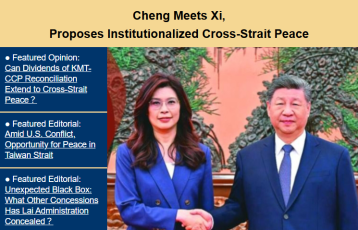
Can Dividends of KMT-CCP Reconciliation Extend to Cross-Strait Peace?
The meeting on April 10 between Chairwoman Cheng Li-wun of the Kuomintang (KMT) and General Secretary Xi Jinping of the Chinese Communist Party (CCP) in Beijing brought her “peace trip” to a smooth close. Yet, as the saying goes, “the people may part, but the melody lingers”—there remains a long and difficult road ahead before lasting cross-strait peace can be achieved.
...read more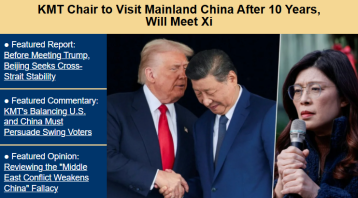
Before Meeting Trump, Beijing Seeks Cross-Strait Stability
Yesterday morning, both the Kuomintang (KMT) and Chinese Communist Party (CCP) announced that KMT Chairwoman Cheng Li-wun will soon visit mainland China. The timing is somewhat sudden, yet not entirely unexpected. After President Donald Trump of the United States confirmed that his visit to China would be postponed until mid-May, Cheng’s trip was only a matter of when it would be announced. What is notable this time is that Director Song Tao of the Taiwan Affairs Office of the CCP Central Committee, personally “authorized the announcement,” underscoring an unusual level of importance attached by the CCP.
...read more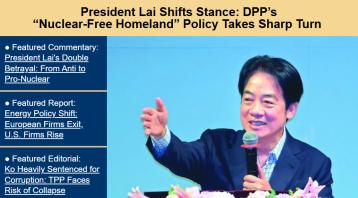
President Lai's Double Betrayal: From Anti to Pro-Nuclear
President Lai Ching-te suddenly announced preparations to restart Nuclear Power Plants Nos. 2 and 3, triggering an uproar within the ruling Democratic Progressive Party (DPP). Civic groups friendly to the DPP administration, long tasked with defending policy, were pushed to the brink and threatened to expand street protests. Supporters are dissatisfied with the president’s all-encompassing justifications, questioning why there was no communication with public opinion, likening it to a sneak attack and a betrayal. In fact, the Lai administration had already signed “tied procurement” clauses in the U.S.–Taiwan Agreement on Reciprocal Trade (ART), pledging “not to purchase any nuclear reactors, fuel rods, or enriched uranium from countries that raise national security concerns.” Without a plan to “return to nuclear power,” why would Taiwan—having reduced nuclear energy to zero—make such a commitment?
...read more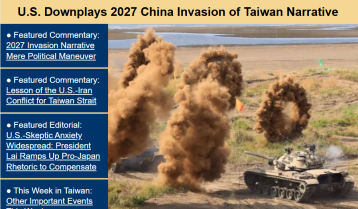
2027 Invasion Narrative Mere Political Maneuver
The U.S. Office of the Director of National Intelligence released its latest annual report on March 18, assessing that China currently has no plan to invade Taiwan by 2027, nor is there a fixed timetable for unification. It further noted that Beijing still prefers to achieve its objectives without the use of force. This assessment effectively undermines the Democratic Progressive Party’s repeated claim over the past several years that Communist China will be ready to complete military unification by 2027. This “countdown” narrative has weighed heavily on the minds of the Taiwanese public.
...read more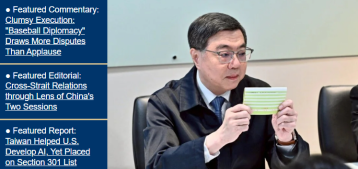
Clumsy Execution: "Baseball Diplomacy" Draws More Disputes Than Applause
Chinese Taipei stopped in the WBC preliminary round. However, the controversy over Premier Cho Jung-tai’s brief appearance in Tokyo to watch the game in person has continued to burn for more than 48 hours, with an apparent determination not to let the matter rest until they see his “self-paid receipts.” A perfectly good ballgame turned into a joke when Premier Cho watched it, and it also turned into political mudslinging.
...read more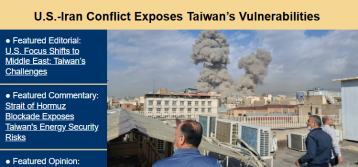
U.S.-Iran Conflict Exposes Taiwan’s Vulnerabilities
On February 28, the United States launched the most intense military strike since the Gulf War. In coordination with Israel, it carried out airstrikes on Iran under the codename “Operation Epic Fury.” Within 12 hours, more than 500 military targets across Iran were destroyed. Iran’s Supreme Leader Ali Khamenei and senior military officials were also killed in a precise decapitation strike. Iran retaliated by attacking Israeli and U.S. military bases in the Middle East. The already fragile regional order quickly collapsed, pushing global politics and the economy into deeper uncertainty. For Taiwan, thousands of kilometers away, the geopolitical conflict in the Middle East not only poses economic challenges and tests Taiwan’s resilience, but under the broader context of U.S.–China rivalry may also create unpredictable bargaining variables.
...read more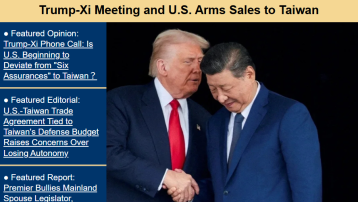
Trump-Xi Phone Call: Is U.S. Beginning to Deviate from "Six Assurances" to Taiwan?
Two international developments in succession introduce significant variables affecting future U.S.–Taiwan relations. First, on the evening of February 16, President Donald Trump of the United States stated aboard Air Force One that he was discussing future arms sales to Taiwan with Chinese President Xi Jinping and revealed that a decision would be made soon. Shortly thereafter, on February 20, the U.S. Supreme Court ruled that the “reciprocal” tariffs imposed by President Trump on nearly all countries under the International Emergency Economic Powers Act were invalid.
...read more